
By Equity In The Center
Between 2020 and 2025, Equity In The Center™ (EIC) became one of the most widely recognized authorities on how race equity is embedded into organizational life. This period coincided with seismic shifts: the height of the COVID-19 pandemic; nationwide demands for justice after the murders of George Floyd, Breonna Taylor, Ahmad Arbery, and countless others; and a philanthropic landscape attempting to reconcile long-standing inequities in its own practices. Organizations across the social sector were urgently searching for tools that could help them respond with integrity and competence.
EIC met that moment by offering stability, shared language, and a developmental roadmap through the Race Equity Cycle™ and its flagship publication Awake to Woke to Work® (AWW), which saw more than 75,000 downloads during these five years . These resources gave organizations clarity on where they stood, how to advance, and what concrete actions would signal meaningful progress.
But EIC’s impact extended far beyond a single framework.
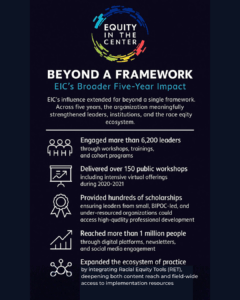 Click To View Larger Infographic
These data points tell a story of scale – but equally important is the depth of learning and sustained engagement that leaders carried back into their institutions.
Phase One: Responding to Crisis and Building Foundations (2020–2021)
The early days of the pandemic created exceptional strain for organizations. Teams were adjusting to remote work; communities were facing disproportionate health and economic impacts; and justice movements demanded institutional responses that went far beyond public statements. During this period, EIC’s workshops and organizational engagements became grounding spaces. Leaders sought immediate guidance: What does accountability look like right now? How do we communicate about race and power inside our organizations? What needs to change in our systems?
EIC helped organizations articulate baseline commitments, understand the stages of the Race Equity Cycle™, and begin examining internal culture and decision-making processes. Virtual programming scaled rapidly and became a lifeline for teams needing structure and shared language amid crisis. Perhaps most importantly, EIC created spaces where staff could process tensions and leaders could confront long-avoided conversations about race and power. The work during this period established the foundation of trust and clarity necessary for deeper transformation in the years to follow.
Phase Two: Deepening Organizational Infrastructure (2021–2023)
As the urgency of 2020 settled into the harder, slower work of implementation, organizations needed more than conceptual grounding. They needed systems, processes, and leadership behaviors that could sustain equity commitments over time.
EIC responded by expanding its focus on organizational infrastructure, supporting leaders to:
- Develop equitable decision-making pathways
- Redesign hiring and recruitment processes
- Update performance evaluation systems
- Establish cultural norms and accountability mechanisms rooted in equity
- Introduce shared leadership practices aligned with Race Equity Cycle™ stages
During this period, the Race Equity Cycle™ Pulse Check™ cohort became a transformative component of EIC’s programming. Hundreds of leaders participated in deep-dive assessments, peer learning, and structured action planning. Many organizations reported measurable change in the years that followed: improved staff satisfaction with equity practices, reduced internal conflict, more transparent decision-making, and stronger integration of equity into strategy and management routines. The shift from awareness to infrastructure was critical. It demonstrated that equity is not a set of one-time activities – it is an ongoing management discipline that requires clarity, investment, and consistent organizational alignment.
Phase Three: Equity as a Management System (2023–2025)
By 2023, the field had matured. Leaders no longer needed convincing that equity mattered. Rather, they needed support in making it operational every day. EIC’s work evolved accordingly, zeroing in on manager practice as the engine of institutional culture.
This phase included the development and dissemination of tools and routines for:
- Equitable feedback practices
- Inclusive meeting facilitation
- Decision-rights mapping and clarification
- Accountability loops that prevent equity commitments from stalling
- Manager-level behavioral expectations aligned with organizational values
This shift represented a strategic breakthrough: recognizing that middle managers, not just executive leaders, ultimately shape whether equity efforts flourish or falter. EIC’s focus on the “everyday work of management” helped organizations embed equity into the smallest units of organizational life: team meetings, workflows, decisions, and interpersonal accountability.
The integration of Racial Equity Tools (RET) into EIC’s portfolio in 2024 further expanded this reach. While EIC trained thousands through cohorts and workshops, RET reached over one million unique users, many of whom relied on its resource library for ongoing, self-guided learning. This pairing – real-time facilitated learning plus continuous-access tools – created one of the most robust field-support ecosystems available in the sector .
Narrative Leadership: Sustaining Visibility and Sector-Wide Accountability
Over the past five years, EIC also played a crucial role in shaping the public narrative around race equity as both a moral and operational imperative. With more than one million social impressions and a monthly newsletter reaching over 18,000 subscribers, EIC’s consistent voice helped normalize the expectation that organizations must invest in equity not as a temporary initiative, but as part of their core operational identity.
This narrative presence reinforced several key messages:
- Equity is measurable.
- Equity is behavioral.
- Equity is a management system.
- Organizations cannot retreat from commitments without consequence.
Even as the sector entered a period of retrenchment marked by political backlash, funding cuts, and decreased institutional appetite for equity-focused work, leaders continued to rely on EIC’s frameworks as they navigated the more treacherous landscape of 2024–2025. The durability of demand underscores both the resilience of the field and the importance of long-term investments in learning and infrastructure.
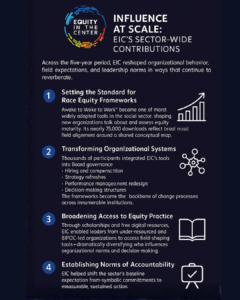 Click to View Larger Infographic
A Five-Year Arc of Transformation
The story of the past five years is a story of evolution, from crisis response to deep institutional implementation to the maturation of equity as a management discipline. During these years, EIC played a stabilizing, clarifying, and forward-driving role for thousands of leaders and organizations. The cumulative impact – captured in metrics, stories, and organizational shifts – demonstrates that EIC has become a cornerstone institution in racial equity practice.
Even amid political backlash and organizational retrenchment, the field continues to carry forward the progress achieved during this period. The need for durable, equity-centered systems remains urgent. And the last five years prove that with the right tools, leadership support, and narrative clarity, organizations can meet this need with intention, courage, and lasting impact. EIC’s work has not only shaped the last five years, it has laid the groundwork for years to come.


